
Distant Horizon needed a sea trial (test run). Since she last sailed, the broken propeller shaft has been replaced; the engine runaway issue has been resolved, among other smaller issues. I wanted a short sea trial to gain confidence in the boat’s mechanicals (engine and such).
Instead, there was a good weather window for a couple of days. There was little to no wind predicted for those two days and a little longer. I was hoping the wind forecast was conservative so I could at least motorsail. That is, even though there wouldn’t be enough wind to move the boat under sail alone, the engine could help make up the difference in speed; resulting in a gentle sea trial for the engine and propeller shaft.
So, I decided to depart São Miguel. I would move Distant Horizon to the Azores’ island, Terceira. This passage should count as the sea trial. I called in advance and reserved a spot for Distant Horizon to winter on land.
On Sunday, October 12th, I departed and said goodbye to São Miguel.
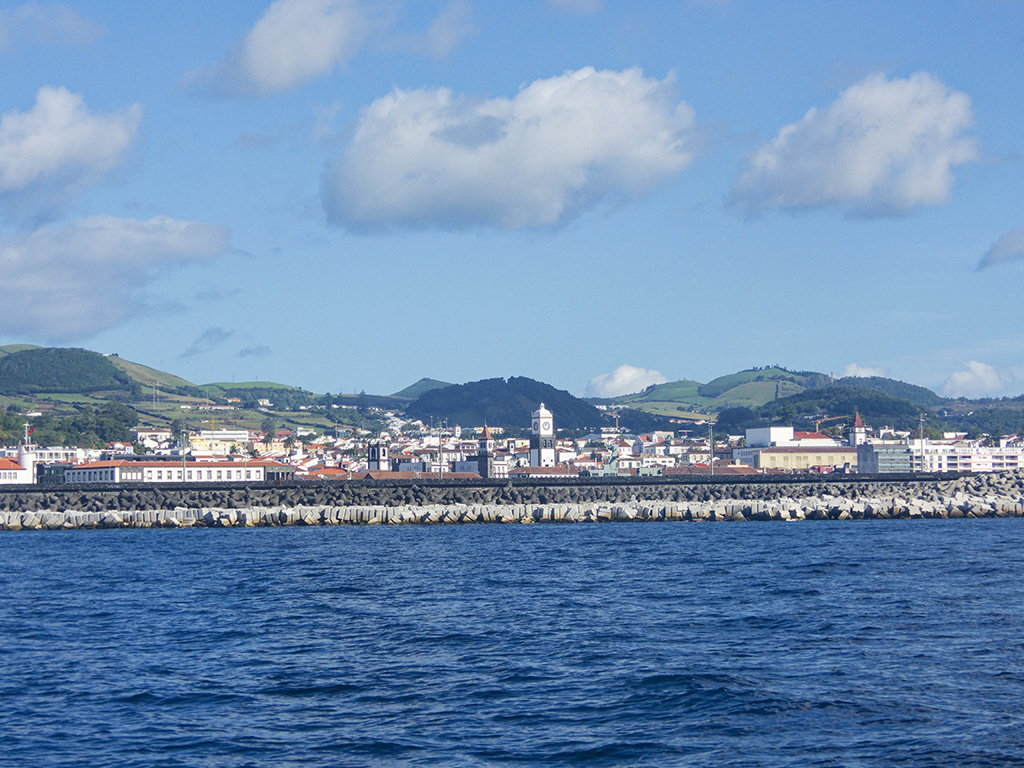
Goodbye Ponta Delgada
I was motoring… into a slight wind, and also into the waves from the past storm, with an untested engine and a newly installed propeller shaft. I was not going to push the boat to make time; precisely why I chose this weather window. I had several days before any significant weather systems were forecasted to approach.
With a fresh breeze, this should be a 18-20 hour passage. With an engine that was untested, I knew it would be longer.
I tried to motorsail, placing the wind at a favorable angle to fill the sails. I was heading more southwest. After 30 minutes, I tacked (turned) back. Again trying to keep a favorable angle with the wind. In theory, and usually in practice, I would be able to sail faster; making up for the added distance of tacking back and forth. In this particular case, that was not true. I could motor directly into the wind at 2.9 knots without making the engine work too hard. I could only go 3,1 knots when motorsailing. I tried this a few times. I thought if I could get past the end of the island, I would have better wind.
As I passed under a benign looking line of clouds, the wind picked up to 15 knots. I was sailing at 4.9 knots with the engine idleing, but the transmission in neutral. I was sailing in the proper direction as well! This wind lasted about 30 minutes. Then I was back to the typical for the day, 6.6 knots of wind.
It took about six and a half hours, but I had finally reached the end of São Miguel Island.
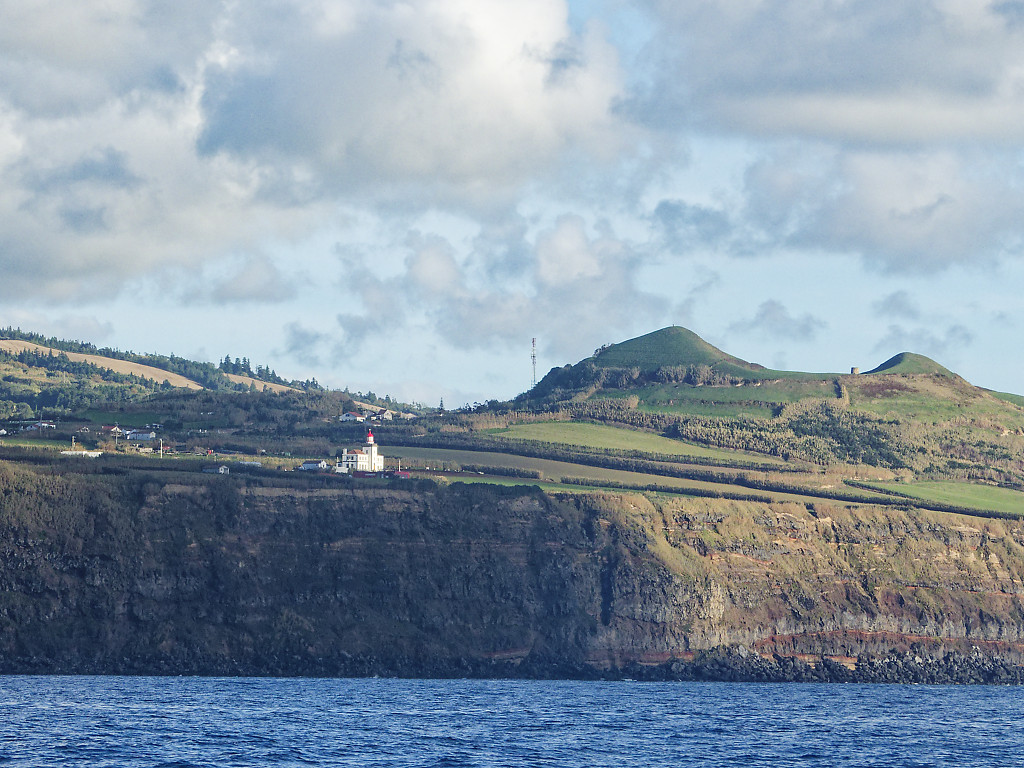
Goodbye São Miguel
I was just getting comfortable on Distant Horizon. Still a little on edge regarding the sea trial and hoping, rather than knowing, all would go well.
However, the island wasn’t ready to let me go just yet. While I was watching the lighthouse slowly slip away, I heard an odd sound. Normally, I’d say a funny sound, but I didn’t want any confusion. This was far from funny.
I turned around. The boom was no longer centered. …and the main sheet blocks were just hanging in mid air. They should be attached to the boat. The mainsheet, or that rope you see in the photo below, is one of the main controls over the mainsail.
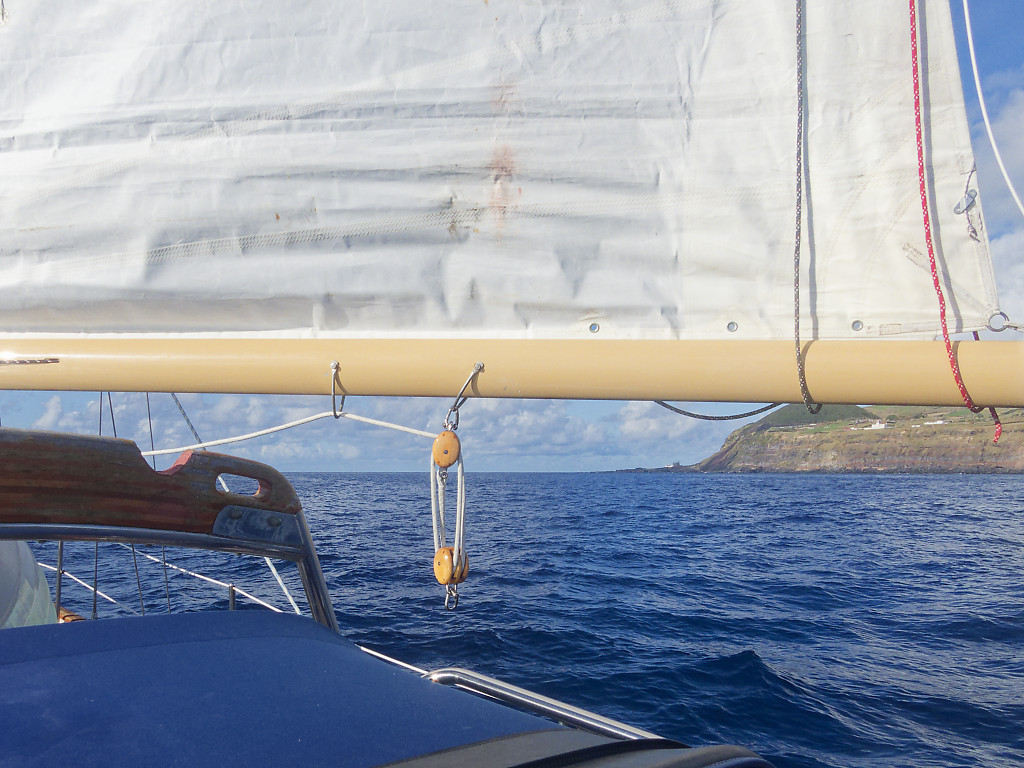
The Mainsheet Broke Away
In these light winds, this wasn’t a problem. In stronger winds, this could be a big problem or catastrophe. I could actually just pull the boom back on center by hand. Then I noticed the shackle was still attached to the block. The clevis pin (the part that holds that shackle to the boat) had slipped away because its locking pin had broken. I found the clevis pin. I carry spare parts on the boat. So, it was fixed in just 10-15 minutes. After taking the photo. 😉
It was early evening; around 5pm. It was hot and sunny. My heart was still beating fast from the free boom episode. I went down below to fill a water bottle and grab a better hat for shade. Afterwards, I was ready to relax and enjoy the boat again.
Squalls
Rather than choosing a favorite weather model, I choose to compare several. When comparing several weather models, you get one of two results. Either they agree meaning the air mass is stable.. and they are all equally right, or they disagree meaning the air mass is unstable… and so you can not trust any of them. Weather forecasting accuracy relies on several models agreeing with each other.
For over a week before departure, none of the models agreed. Sometimes they were all wrong just 12 hours from the forecast! I knew I had a very unstable airmass. I have written a computer program to provide me with basic wind information from the Surface Analysis Chart from any weather model. I was getting decent results as far as accuracy goes.
What was not forecasted by NOAA (GFS), Portuguese Weather (ECMWF European model), The UK (UKMO), was significant vertical movement. In non-technical terms… unstable airmass + warm air rising quickly = Squalls and/or Thunderstorms!
I have sailed through many squalls; usually much farther south going to the Caribbean, Bahamas, or Bermuda. The first squall today took me completely by surprise. It was just a low hanging cloud, slightly darker than the rest but not threatening.
As I approached, the winds started to pick up. The winds in a squall will nearly double in strength. Since I was in roughly 5 knot winds with all sails up, 10 knots would be nice. I would try to sail for the 15-20 minutes. As was typical for this passage, this was not a typical squall. The winds went to 20 knots, which the boat could handle with full sails. It was just nerve racking to start a passage this way.
30 minutes later, I was back to the 5 knot winds. Unfortunately, I did not encounter rain. That would have helped cool me off and also, it typically flattens the waves; making motoring easier on the engine.
It didn’t take long before another squall appeared in the distance. I chose to take this on under full sail. I didn’t want to take the time and expend the energy to put in a reef; make the mainsail smaller.
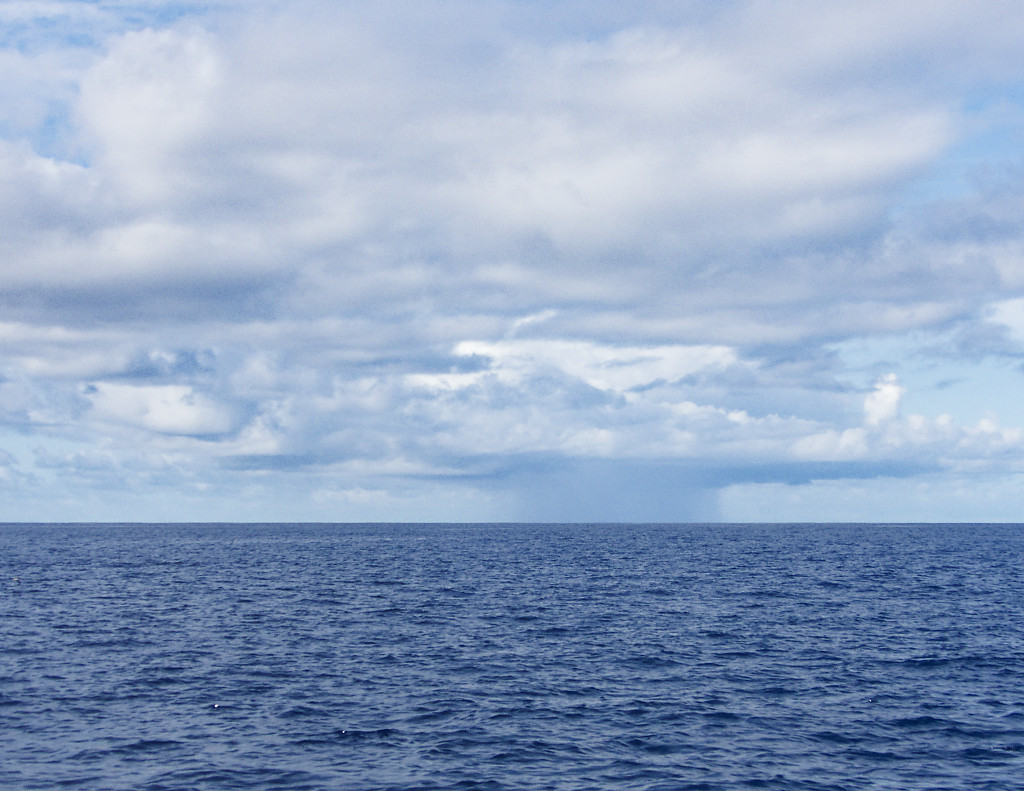
A Distant Squall
This one passed quickly. It had almost exhausted itself by the time we met.
However, as I came out of the squall, I noticed that was just one of many, I was approaching what looked like a squall line… in line with the direction I was sailing. I had no time to change my mind about that reef!
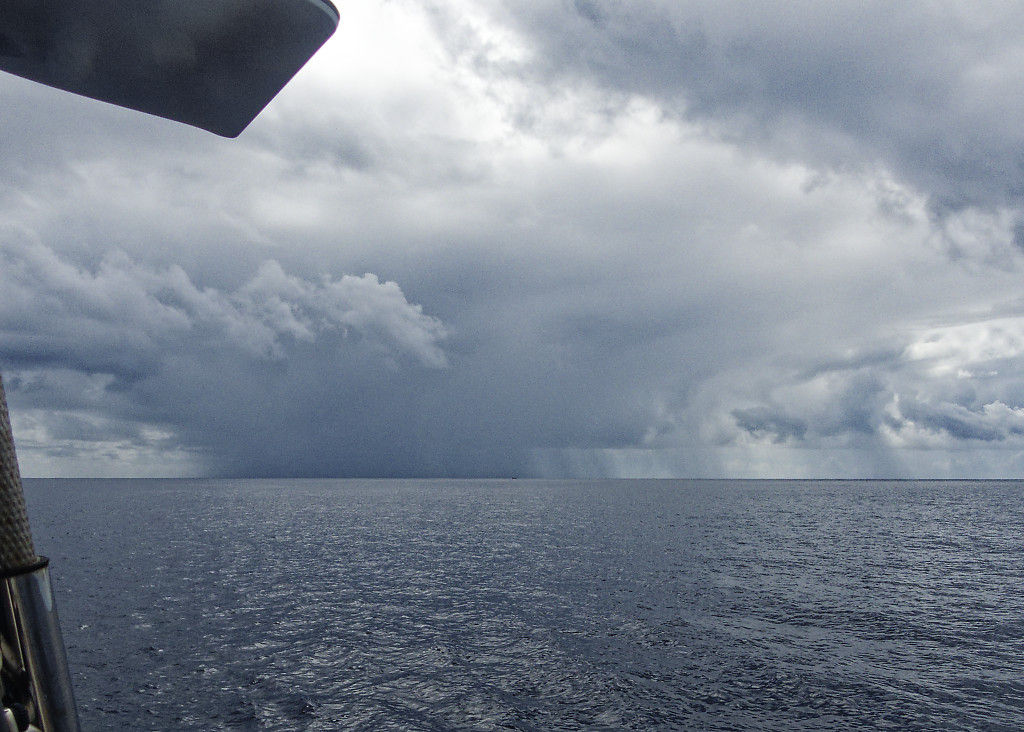
A More Threatening Squall
This next squall was a nasty one in several regards. It obstructed my view of what was on the other side. It’s max winds were over 28 knots. It poured cats and dogs. I tossed my glasses aside so I could see better. It also had a larger wind-shift than expected. This was a full blown squall with a lot of vertical lifting; creating its own micro low pressure system.
I was hand steering, reaching as high (into the wind) as the boat would allow so as not to put too much pressure on the sails. It required full attention to wind, waves, and sails.
My first day back on the boat in over two years. Not quite the relaxing day of light winds that I was expecting.
Twenty minutes later, the winds were easing. Then they would pick up again. In a short while they would ease even more. The cycle would continue for another 10-15 minutes. I thought that has to be the end of it. That squall never should have happened at this latitude.
When I could finally see clearly again… There was another squall, right there on top of us. This went on for a total of six squalls in a 3 hour period. In hind-sight, it was just a small squall line of about 15 miles. Farther south they could be double that size.
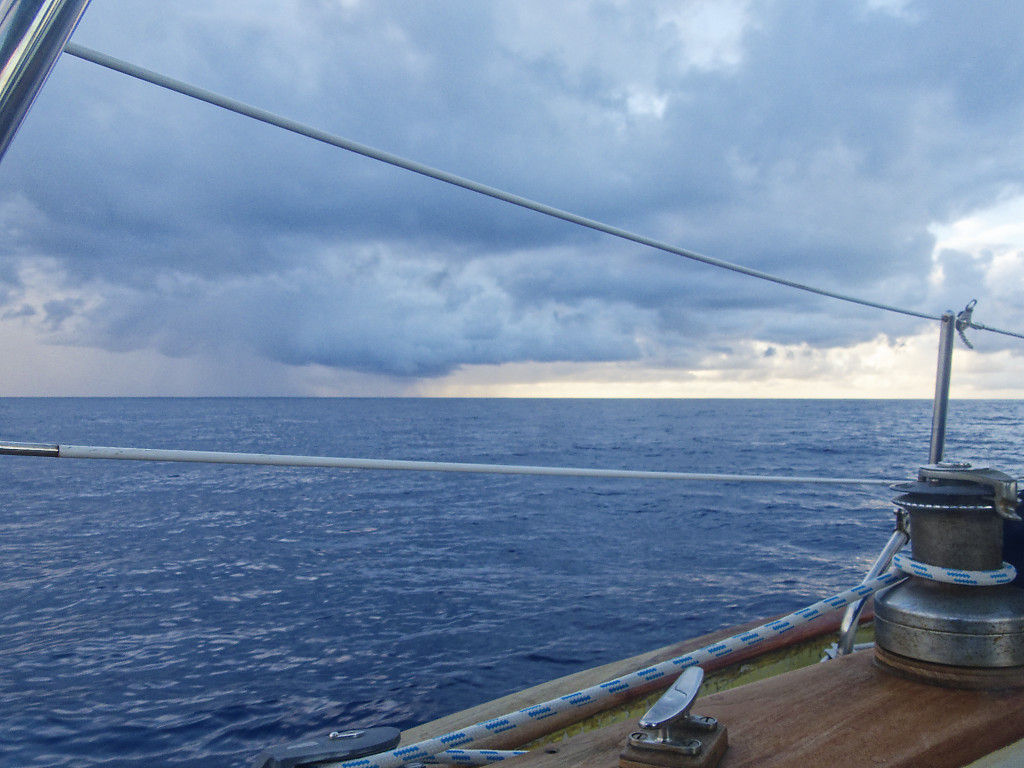
The Final Squall… a Baby Squall
Through all that confusion and chaos, The old Perkins engine kept us moving just enough to manage without issue. The propeller shaft was still working fine. The propeller shaft is kind of a go no-go item. There is no easy way to continuously check on its status or even notice visually that something was not right.
Thankfully, that was the end of the squalls. It was starting to get darker now and the sky was starting to cloud over as the sun set. I was hoping for a first sunset photo at sea, but that was just one more minor disappointment. All the big items were successes, though.
A Long Dark Night
There was no moon that night. For about an hour, I could see the Big Dipper. Then the sky was just black. The sea was black. There was no way to distinguish one from the other. I could hear the water rushing past the hull. I could hear the waves over the sound of the engine. I could feel the boat pitch up, or suddenly decelerate as she reached the bottom of a wave. I had to sail by feel, a GPS heading that constantly changed as the boat pitched and rolled, and a magnetic bearing which also change constantly.
I knew Distant Horizon was not struggling at all. The oil pressure for the Perkins engine was good. The water temp was a little high, but not enough to cause concern. I kept hoping the old Perkins was actually doing as well as the instruments indicated. I did not want surprises in the middle of the ocean on a pitch black night.
Steering was work! I was still getting my sea legs.
Thankfully, there were no more squalls that night, and the winds stayed at a nice 17 knots. So, I turned off the Perkins and gave it a rest. I was sailing with all sails at 3.5 knots to almost 5 knots in a good direction towards my destination.
This also gave me a break from steering. The Hydrovane could steer the boat when it is under sail.
About 2am, I received a message from my daughter, Grace. The Packers won 27-17! … and my favorite player, Josh Jacobs was on fire… now I regretted not seeing the game. I had to go with the good news and let go of the regrets. That lifted my spirits!
Motoring Again
About 3am the wind had dropped considerably. Distant Horizon was still sailing, but too slow. So, I started the Perkins again. It had a nice long rest and only used a little oil, which is typically what she does. They say, “If your Perkins isn’t using oil… your Perkins doesn’t have oil.”
I was happy when dawn approached. At least my tired eyes could use the horizon again.
As I typically do, I log basic information every two hours. I checked our current position. We were disappointingly not quite half way. I was hoping for a 30 hour or less passage, It was clear now that it would be longer, much longer.
It was Monday, October 13th. I was motoring at a moderately gentle pace with all sails up. They weren’t helping, but they weren’t hurting either. In the log book I wrote “Furling the jib and dropping the staysail for 15 minutes to determine the impact on speed.” There was none. So, the sails went back up. Sometimes when motoring, the sails will provide drag and slow your progress. Verifying that was not happening was a highlight to the start of a new day.
There were moments of the sky beginning to cloud over, but then it would clear up again. Distant Horizon and I were finally working together and making slow but consistent progress. I had hoped for 4 knots on average. We were making about 3 knots. The difference meant an additional half day for the passage. That was good news. I would still have a little more than a 12 hour cushion to make my arrival safely.
There was a haze on the horizon ahead of us. There were darker clouds forming behind us. I started to worry that the weather system behind me was accelerating. It would be coming from the Southeast. Cold Fronts are best know for accelerating and they would come from the Northwest. So, I would calm my mind and continue on.
A Night Arrival
Then, shortly after breakfast, it happened. Through the haze, I could see a slight form of a mountain. I was getting close. I checked my position. The bearing towards the shadow was correct for Terceira. It was 38 miles away… at 3 knots, that meant 13 more hours. I would arrive between 11pm and midnight. 🙁
Near sunset, the haze had lifted. I was getting my first clear glimpse of the island.
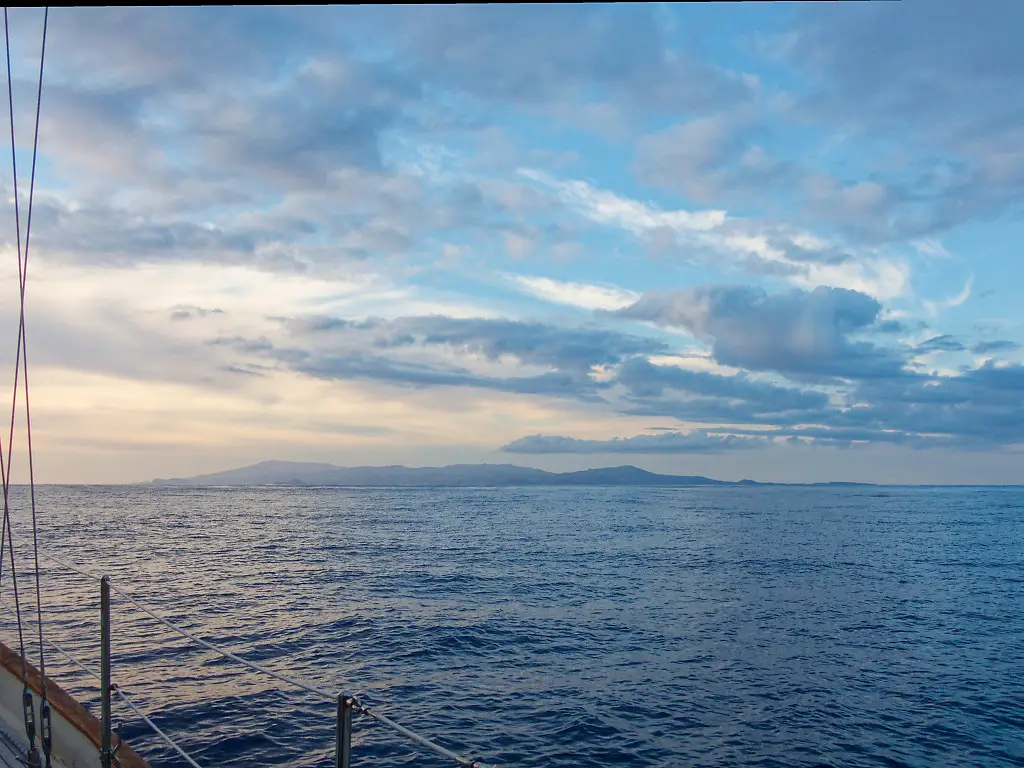
Terceira at Sunset
I can’t lie. I had angst about entering a harbor for the first time, in the dark. It’s almost a rule to not do that. However… waiting until morning would mean entering a harbor for the first time, possibly in a storm. Between the two options, I chose a calm dark night.
A while later, my friend and fellow sailor, Dan, messaged me. He was on the computer at his boat in Virginia. He had been following my progress using my tracking map. He understood my slow progress because he had checked the weather at my position.
He was curious about making landfall at an unfamiliar harbor in the dark. He was looking up information about the Marina, the harbor, the navigation markers, and Google Earth satellite view, which was a daylight view of where I was going in the dark.
Dan and I text back and forth for several hours until I was approaching the bay I needed to enter to reach the marina’s entrance. He knew I would stop in the bay to drop my sails and prepare for docking. There was still very light winds and lots of room. This would be a stress free reset for me; knowing I was prepared to dock.
During that time, Dan was silent. When he noticed Distant Horizon started moving, he warned me that there were exposed rocks near the breakwater. So, I should give it a wide berth. I did. On this moonless night, I would have never seen the black volcanic rocks in the water. There was no lighted warning marker there; only the channel marker high up on the breakwater.
From the bay, we turned to starboard (right) to reach the Marina entrance. However, that is actually the port entrance. Once inside the port, the marina is a port (left) turn. As I made that final turn, a security guard was standing at the reception dock and shouted for me to take the slip after the second boat. He had to know I was coming, because he spoke in English right away rather than Portuguese.
He met me at the slip. I didn’t know exactly what to expect when I reached that slip. It certainly wasn’t a strict over bearing security guard. He waited at the end of the slip while I turned my boat to go stern in (back in). I have a rule about docking… Never go faster than you’re willing to crash. Boats don’t have brakes.
When we were within close proximity, he said, “Toss me that line”. I did. Then he asked if I wanted him to take it all the way back. I said yes. The slip could easily fit a 50′ boat. My little 35′ boat had plenty of room.
After Distant Horizon was secured. He simply pointed and said, “The office is there. They open at 8am. You need to check in at 8am. okay?” I assured him I would. Then he shook my hand and said, “Welcome to Angra” and left. Angra, being the city where I am now located.
It was 1:30am on Tuesday, October 14th.
Out of the 39 hour passage, I used the engine for 31.4 hours. The old Perkins engine ran well, not perfect, but well. All issues are easily resolvable. I made a list. The propeller shaft also having its first real world test, did perfectly. The boat will winter on land in the city of Angra, on the island of Terceira in the Azores. I will fly back to the states next Tuesday.